YOUR NAME. YOUR STORY. UNDERSTAND THE DIFFERENCE.
Your name in kanji.
More than a sound.
What to know before turning a name from another language into a Japanese tattoo.
A personal name can make meaningful art. Start by deciding what you want the writing to represent: your name’s sound, its origin, or a story you choose to tell.
Explore documented Japanese name examples →
Compare source-reviewed name examples →
02 · ORIGIN
Explore its meaning
Research the name’s language and origin before choosing a Japanese word.
Explore the meaning →03 · PERSONAL STORY
Choose a symbol
Select a word that reflects a value, memory, or aspiration.
Explore your story →Start with how you say your name
Modern Japanese commonly uses katakana to write names from languages that do not use kanji. Katakana represents sound; it does not assign a separate dictionary meaning to each letter of your name. Names already written in Chinese characters can involve different conventions.
Use your own pronunciation as the starting point. The same Roman-letter spelling can be pronounced differently across languages or families. Japanese sound patterns may require an approximation, and more than one spelling may be reasonable. A recording and the language of your name help a Japanese reader assess the result.
Katakana is a complete design choice in its own right. You do not need kanji for your name to be written in Japanese.
What is ateji?
当て字 (ateji) uses kanji readings to represent a word’s sound, rather than relying on the characters’ meanings. A custom name design can take this approach while also choosing characters whose associations matter to you.
That creates a distinction worth keeping: an established spelling is not the same as a spelling newly made for you. A creative name may need a pronunciation note. It does not automatically become a familiar Japanese name or a word that every reader will recognize.
Ask which reading supports each sound. A kanji’s reading in one word does not mean you can use it in every combination, and taking only part of a reading needs explanation.
Good meanings do not automatically make a phrase
Choosing characters with positive dictionary meanings can be a thoughtful part of a design. But lining up their English glosses does not create Japanese grammar or guarantee that the combination expresses a complete thought.
Separate three questions: what each character can mean, whether the whole combination is an existing word, and what you personally want it to symbolize. Your explanation can be meaningful even when a stranger would not infer it from the lettering alone.
A useful way to describe it: “This is a creative spelling of my name. These are the associations I chose for it.” Avoid presenting that personal explanation as the phrase’s literal Japanese translation.
Translating a name’s origin is a different choice
If you want a tattoo based on what your name originally meant, verify its origin in a reliable source for that language first. Names can have several origins, and popular name-meaning lists do not always agree.
Then check a suitable Japanese word in context. The result may express the original idea without sounding anything like your name. Explain it as a tribute to your name’s meaning, rather than the standard Japanese spelling of your name.
A personal symbol can stand on its own
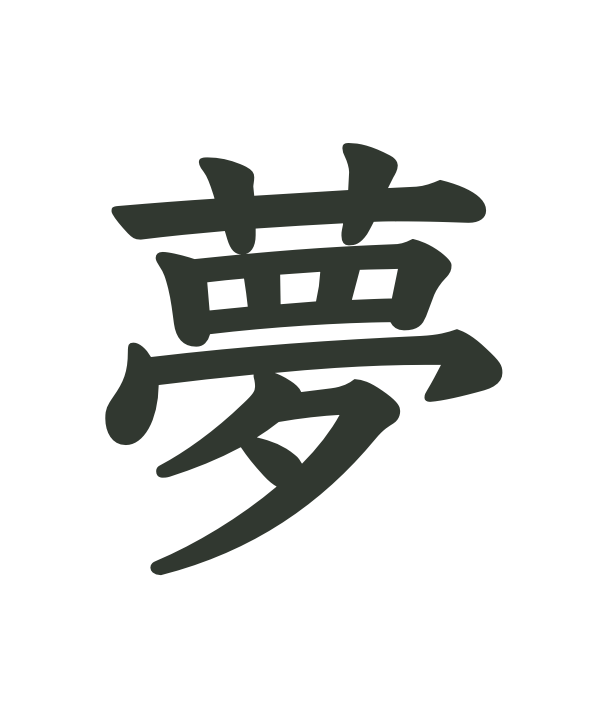
Dream
yume / ゆめ
You can keep your name in its original script and choose a separate Japanese word for something you value. For example, 夢 (yume) can refer to a sleeping dream or a future aspiration. It does not, by itself, say “my dreams will come true.”
This approach lets the word keep its own reading while you explain its place in your story. There is no need to force it to sound like your name.
Read Dream’s meanings and context →Ask for an honest reading before explaining your intention
Show a fluent Japanese reader the characters and ask, “How would you read this, and what does it suggest?” Then share your intended pronunciation and story. This helps distinguish what the writing communicates by itself from what becomes clear after an explanation.
Ask about unintended words, awkward combinations, alternate readings, and whether it looks like an established name or a deliberate invention. A reader may like the creativity while still explaining that the expression is unusual. Those observations can both be true.
Once you understand the trade-offs, a personal spelling remains your artistic choice. The aim is an informed decision, not a rule that every tattoo must be an everyday word.
Take the final artwork to your artist
- Record your intended pronunciation in kana and explain your personal meaning separately.
- Check the exact characters, order, and complete phrase with a fluent reader.
- Have any cursive or historical lettering reviewed by someone familiar with that script.
- Review the actual drawing and transferred stencil, including orientation, spacing, and complete strokes.
- Discuss size and legibility with your artist; a screen preview is an approximate reference.
This dictionary explains existing entries and offers lettering references. It does not automatically generate or certify kanji spellings of names, and a tattoo design is not proof of an official name spelling.
Sources & editorial approach
This guide is written in English by a Japanese site owner. The explanations and design advice are editorial guidance, not endorsements from the sources. No private messages or identifiable customer examples are reproduced here.